
We have developed some answers to common questions we have received from our members on the Vet-VB-CAB relationship below. These two fantastic presentations by our Certificated Members further explore these issues:
What does a referral look like?
Our members only see cases on written vet referral, thus taking all reasonable steps to ensure that all actual and potential medical causes for problem behaviour in an animal have been identified by a vet prior to behavioural assessment. Note that a verbal referral, such as over the phone, is not sufficient. Written referral can take the form of a letter, email, fax, online form, or simply a note recorded in the animal’s clinical history naming the behaviourist. You may request the referring vet to also send a full clinical history for further background on the animal you are going to see, but receipt of a clinical history is not a referral in itself. If there are multiple animals in the household who may be having an influence on the reported behaviour problem, then request the vet to consider referring all of the relevant animals.
What counts as a training or a behaviour case?
Behaviour cases include all types of undesirable, inappropriate, problematic, or dangerous behaviour, whereas training involves teaching an animal to undertake specific activities on cue. If the case could be described as one of the behaviour presentations linked on this page, then a vet referral is required.
Is a referral needed for providing first aid behaviour advice?
If, for instance, you already have a relationship with a training client, but you realise there may be a behaviour issue involved, then you may give preventative and prophylactic first aid behaviour advice, but then direct the animal to their vet for a full medical check-up and behaviour referral.
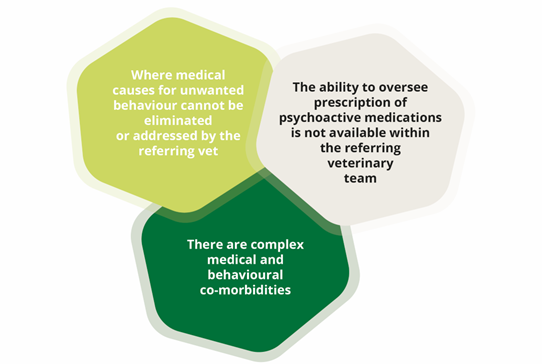
When should a case be referred to a Veterinary Behaviourist?
Where medical causes for unwanted behaviour are suspected but cannot be adequately addressed, when a referring vet feels that psychoactive medication may be indicated but does not feel confident to prescribe it without support, and when the animal has a complex medical history, then referral to a veterinary behaviourist is advised. A Veterinary Behaviourist would also be appropriate if there may be polypharmacy involved, or a lack of response to a behaviour treatment plan.
How should referring vets be updated during the course of a case?
Beyond your initial written behaviour assessment to the referring vet, it may later be helpful to update them after every session or contact with the client, particularly after new behavioural advice is given. It would also be helpful to let the vet know the current outcome of a case at clinically significant points, such as towards the end of an analgesia trial, or 4-12 weeks after starting a long-term anxiolytic. If you are struggling to hear back from a client, or have concerns about their actions, particularly if, for instance, their non-adherence to the suggested behaviour modification plan increases the risks to others, then let the vet know in writing.
How can CABs discuss potentially influential health issues?
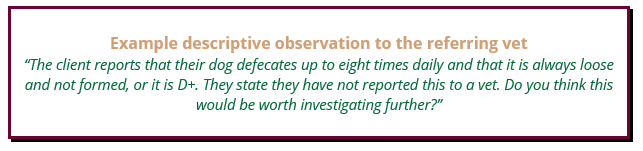
Our non-vet members may be able to identify the potential involvement of some form of medical issue for discussion with the referring vet, but they cannot legally or ethically make a diagnosis. For instance, you can pass on your observations of an animal from a consult to their vet, describing behaviours you think may indicate pain or discomfort, but it is up to the vet to decide what the medical issue is and, indeed, if there is one at all. Sometimes the owner providing brief video footage or a diary to their vet is helpful alongside your observations.
Likewise, our non-vet members are bound by our Code of Conduct not to give any specific form of physical health-related advice to owners. Nonetheless, they can discuss with the referring vet the impact of various forms of physical health on behaviour with reference to up-to-date, reliable scientific literature. This includes areas such as dietary modification, neutering, pheromonatherapy, or complementary products with active chemical ingredients.
How can CABs discuss medication?
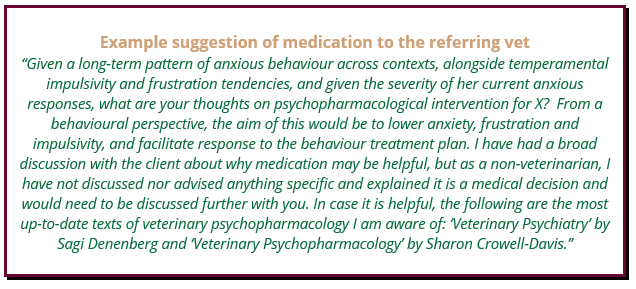
Referring vets and Veterinary Behaviourists remain responsible for any psychoactive medications and minimising the risks of any side effects if prescribed. Our non-vet members may discuss adjunctive medical treatment of a behaviour case with the referring vet by referencing the current and established scientific literature, but they must not provide any advice on specific appropriate treatment, medical interventions, or specific classes, types, side effects, or doses of medication. For instance, a CAB may discuss with the vet (not the owners) the potential usefulness of analgesia trials supported by relevant papers but cannot name specific drugs like meloxicam or dosages.
What if health issues crop up partway through a case?
Some of our vet members offer remote behaviour advice or support services to our non-vet members to discuss aspects of cases. Sometimes, the input of a Veterinary Behaviourist is useful partway through the treatment of a behaviour case which has already been referred to a non-vet behaviourist. Our fellowship can facilitate cases, for example, when a previously unforeseen medical condition is identified, or unexpected circumstances develop which require psychoactive medication. This type of relationship is particularly useful in areas where there are few VBs. Read the further guidance on this type of collaboration here.